
From Curiosity to the Space Coast: An ARC Finalist’s Journey with BRPH

At just 18 years old, William Fraze is already charting a course toward the stars.
Currently a freshman at the University of Louisville’s J.B. Speed School of Engineering, William is pursuing a degree in mechanical engineering with his sights set on aerospace exploration. His journey began with a childhood fascination with rocket launches, which led to competing as a finalist in the Aerospace Industries Association’s (AIA) American Rocketry Challenge (ARC), the world’s largest student rocket competition. That path brought William all the way to the Space Coast through BRPH’s Rocketry Challenge Contest, demonstrating the transformative impact of hands-on learning and opportunity in science, technology, engineering, arts and math (STEAM) education.
Like many aerospace origin stories, William’s passion for space began early. As a young child, watching old video footage of Apollo and Space Shuttle launches sparked his imagination, but it wasn’t until William saw a SpaceX Falcon 9 launch live for the first time that everything changed for him.
“As a nine-year-old, I remember thinking, this is what I want to do: make the impossible possible,” William recalls.
That moment set him on a path toward mechanical engineering, a discipline he sees as a gateway into rocketry, orbital systems, and ultimately, our future beyond Earth. With plans to earn his master’s degree by 2030, William hopes to contribute to interplanetary exploration for a return to the Moon and a landing on Mars.
AIA’s American Rocketry Challenge
William’s interest in aerospace became clearer when he joined the Hart County 4-H Rocket Club in 2023. Along with three teammates and a few dedicated mentors, he helped relaunch the team after a COVID hiatus. None of the students had much experience in amateur rocketry, but they all learned quickly.
William led hands-on design work for the finals, while teammates focused on body tubes, nose cones and recovery systems. The competition demanded extreme precision in altitude and flight times, so the team even began assembling their own rocket motors, a very precise process that left no room for error.
Out of 1,001 teams across the country, only 100 advanced to the ARC National Finals. William’s team, one of the smallest among the competition, earned their place and traveled to Virginia to compete, finishing as the highest-scoring team from Kentucky.
“We didn’t win the day,” William says, “but we were all grateful for the experience.”
More importantly, ARC taught him lessons about teamwork, problem-solving and resilience. Lessons that will stay with him far beyond the competition. Whether it was redesigning a faulty launch rail or adapting to unexpected wind conditions, the experience mirrored some real-world engineering challenges.
Winning a Trip to the Space Coast
As an ARC finalist and BRPH’s contest winner, William and his family traveled to Florida’s Space Coast for an unforgettable behind-the-scenes experience.
One highlight came bright and early at 3:30 a.m. on December 16, when they watched a rocket launch from a nearby rooftop overlooking Cape Canaveral.
“The flame trail appeared more brilliant than sunlight,” William says. “I felt the heat instantly. The low rumble filled the earth, and it was like rolling thunder and a small earthquake combined.”
For William, seeing a rocket launch in person was more than a spectacle. It was confirmation that his dreams are real and within reach.
Engineering in Action
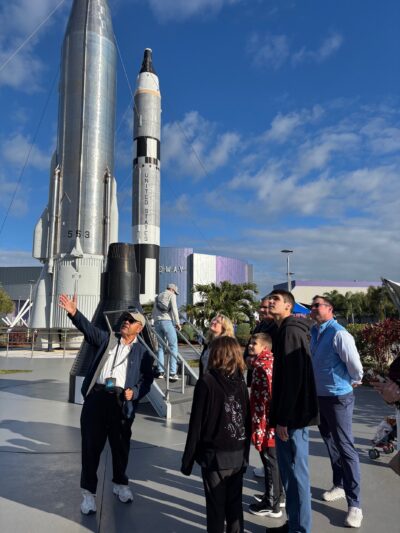
During the private VIP tour of the Kennedy Space Center, William got to walk among real rockets, including the Saturn V moon rocket. William was also given the opportunity to speak with an astronaut, and gained a new appreciation for the scale of achievement in spaceflight. The one moment that stood out for him was seeing NASA’s orbiter, the Space Shuttle Atlantis.
“The way BRPH designed that display truly made it feel like gravity was being defied,” he says. “It’s amazing that a vehicle as heavy as 4.5 million lbs. could be lifted to space. And the reveal was breathtaking.”
That sense of awe continued at BRPH headquarters, where William spent time in the “Corner Cave,” BRPH’s collaborative visualization space.

There, he learned about real-world engineering challenges like last-minute launch pad modifications and the complexities involved in building a massive hydrogen storage system, all brought to life through immersive screens and 3D modeling.
“It’s not hard to imagine how useful a tool like this would be in a working environment,” William notes.
Perhaps the most lasting impact of the trip was how it reshaped William’s understanding of engineering itself. Through conversations with many BRPH team members, including Jimmy Woodard, National Practice Leader, Process Piping, he came to see that real-world engineering is as much about collaboration, communication and building consensus with people as it is about technical expertise.
“You think engineering is about machines,” he reflects, “but really you’re working with people.”
From BRPH’s design philosophy displayed on the walls to the welcoming culture throughout the office, William saw how collaboration and creativity are central to solving complex problems. The experience reinforced his desire to surround himself with passionate, driven people and to bring his best to everything he does in the future.
Advice for the Next Generation of Engineers
For students interested in rocketry or aerospace, William offers simple but powerful advice: talk to people who’ve been there.
During an impromptu visit to the American Space Museum in Titusville, William met former NASA propulsion engineer Warren Wiley, who reminded him that success often begins with human connection. Whether with a neighbor, a mentor or through a chance encounter, it’s those connections that teach us and can even shape the course of an entire career.
“It reminds me that we should look back at where we’ve been as we look forward to where we want to go,” William says. “Anything is possible for those who have the willpower to overcome hurdles and who care enough to keep moving forward.”
William’s story is exactly why BRPH proudly sponsors AIA’s American Rocketry Challenge, and invests in STEAM education nationwide. By supporting students today, we help shape the engineers, innovators and explorers of tomorrow, to turn their curiosity into discovery and dreams into reality.
Learn more about our partners and the Space Coast museums mentioned in the blog: