
Road to Nationals: How students from a Georgia STEM school built the ultimate rocket and earned their place among the country’s best.
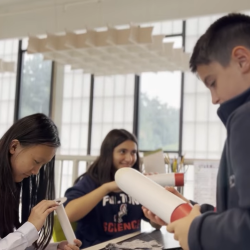 It started, as many great things do, with something that looked cool. “I joined because it looked cool,” admits Jayden, an eighth grader at the Fulton Science Academy (FSA) who had never built a rocket in his life before this year. His teammate Davud was drawn in by a lifelong fascination with aerospace and aviation; Jiwon wanted something more exciting than Math or Science Olympiad; Annabel, now a junior, wandered in as a freshman looking for an extracurricular and never left. Today, all four are packing rockets, epoxy, spare fins and 3D-printed mass components into a car headed for the American Rocketry Challenge National Finals.
The AIA American Rocketry Challenge is the world’s largest student rocket contest. Teams of middle and high schoolers design, build and fly a model rocket to hit a precise altitude target (750 feet this year) and return within a tight time window (36 to 39 seconds), all while keeping a raw egg passenger alive and intact. Every foot off target, every fraction of a second outside the window, costs points. Like golf, you want zero.
Out of more than 1,000 teams that enter each year, around 100 make it to nationals. FSA’s competition team of Annabel, Davud, Jiwon and Jayden, are among them. This is the school’s second trip to the national stage, and this time they’re coming with something they didn’t have last year: data. And a lot of it.

The Science of Obsession
Their faculty advisor, Dr. Ramin Adams, is by training a political scientist with two master’s degrees and a PhD. He doesn’t design the rockets — contest rules prohibit it — but he has built something arguably more valuable: a culture of rigorous experimentation inside FSA’s innovation lab, a room that doubles as a bedroom for students during the all-night build sessions that have become a regular feature of their season. “They don’t sleep weekends,” he says, without exaggeration.
The methodology would be recognizable to any working engineer. Before every launch, the team logs the weight of each component — body tubes, nose cone, even the egg — along with motor specs, temperature, humidity and barometric pressure. After each flight, they record altitude, descent time and any anomaly. Then they do it again. And again.
The team splits into sub-groups to test competing designs in parallel, then iterates toward the most consistent performer. Simulation software called OpenRocket lets them model altitude and flight characteristics before a single motor is lit. But everyone on the team has learned the hard way that a perfect simulation and a real-world flight are two very different things.
“The toughest part isn’t the science itself,” Dr. Adams observes. “It is working with real world conditions. You can control your rocket, you can program it, you can use mathematics. But you can’t control climate, you can’t control wind.”
Finding a Field
Before they could test a single rocket this season, the team had to solve a more mundane problem: finding a place to launch. Local rocketry clubs offered fields, but with only one launch day per month shared among dozens of members, the math didn’t work for a team that needed to fly multiple rockets, multiple times a week. So Davud started calling.
Farms. Airstrips. Any open land with enough sky above it. He called dozens of landowners before finally securing access to a field in Griffin, Georgia, close enough to use on short notice. That discovery came just in time and without it, last year’s nationals run might never have happened.
Now, preparing for the national competition in Virginia, the team faces the same challenge all over again. Conditions there are different: higher elevation, different barometric pressure and historically brutal wind. To gather data specific to those conditions, Davud called another 80 farms in the area. He found one that said yes. It’s called Mary’s Alpaca Farm, and yes, there are alpacas.
More Than Rocket Science
Ask these students what the competition has taught them and the answers reach beyond aerospace. Annabel, who joined as a freshman chasing a hobby and stayed because of the community, describes a shift in how she thinks about success. “When I first joined, my main extracurricular was math competitions. The emphasis was always to place, to win. But in rocketry, I’ve learned that the testing, the process, the reiteration; and the friendships and overnights have been the most fun. The process can often be more important than how well you actually perform.”
Davud, now one of the team’s more experienced builders despite still being in eighth grade, has learned to improvise. “What I work on most is simulation, theoretical stuff. But when you get to the launch and the climate is different or the wind is blowing a different direction, you need to be able to change your launch angle, add some mass, change your parachute. Seeing that something is different from what I simulated and adjusting to it in real time — that’s one of the most important skills I’ve learned.”
Jiwon came in lukewarm on engineering and found herself genuinely excited about aerospace. Jayden discovered an entire professional field he didn’t know he cared about. And Annabel, a junior who initially wouldn’t have expected to spend her high school years alongside eighth graders, has learned how to be a teammate to people across age groups. It’s a skill, she notes, that can be used in future professional environments.
Hakan Akel, another teacher who supervises the team and often sleeps alongside the students during late builds, frames it in terms that go beyond engineering. “I keep telling them: the rocket is a symbol of your goals, your plans for the future,” he says. “Turn your face toward the sun and let the rocket rise. Everything negative stays behind you as your shadow. You just always go to the top, no matter the challenges.”
The Forecast
The team’s qualifying score of two on their first flight of the season, one of the best possible results, earned them their spot. Their goal at nationals: finish in the top 10.
They’ll arrive in Virginia with six rockets, boxes of spare parts, 3D-printed mass adjusters to fine-tune altitude in real time and a binder’s worth of flight data. They’ll watch early flights on the scoreboard to read how the wind is behaving, adjust launch angles accordingly and hope the weather cooperates. If it doesn’t — and it didn’t last year — they’ll adapt.
What they’ve built this season isn’t just a rocket. It’s a repeatable system, built on hundreds of data points, sustained by sacrifice and held together by a team of students who keep showing up. Through bad flights, sideways rockets, sleepless nights and 80 unanswered phone calls; because the process turned out to be worth it.
The launch window opens soon. The alpacas are ready. And so are they.
About BRPH — BRPH is proud to support the American Rocketry Challenge as a sponsor of the national competition. As a firm with deep roots in aerospace infrastructure — from launch pads to satellite processing facilities — BRPH believes that the next generation of engineers is being shaped right now, in labs, on farms and in late-night build sessions exactly like the ones happening at FSA. We’ll be on the launch field cheering them on.